
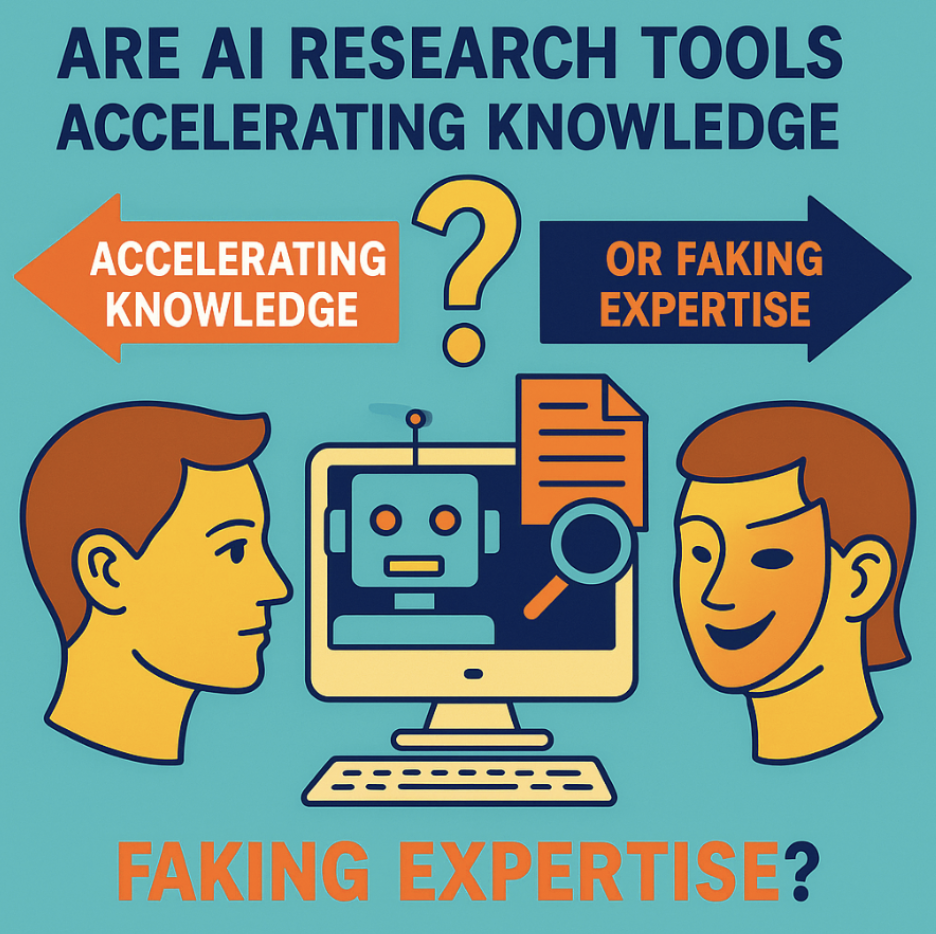
In the past five years, academia has undergone a silent revolution. Not because scholars suddenly became more efficient—but because AI research tools quietly slipped into the workflow of nearly every student, PhD candidate, and early-career researcher.
From best AI for a PhD research engines to free summarizers and AI for literature review, the new academic toolbox looks nothing like the old one. And honestly? It’s transforming not just how we work, but how we think.
But here’s the uncomfortable question:
Are we building deeper knowledge—or outsourcing the thinking altogether?
The Tools That Promise “Instant Expertise”
A single search reveals an entire ecosystem designed for one purpose: speed.
Students once spent days reading journal articles. Now they paste a PDF into an AI abstract generator or a summarization generator, and within seconds, they’re handed what looks like a polished, coherent summary. Tools like ai summarizing tool, free summarizing tool, and ai article summarizer free have become default study aids—often replacing the need to actually read.
For higher-level research, things get even more extreme.
Platforms like AI for scientific research, AI research paper generator, and AI journal generator don’t just summarize work—they produce work. Some even claim to generate publication-ready papers, raising the unsettling possibility that a portion of academic literature in the future might be machine-written.
Convenient? Absolutely.
Terrifying? Also yes.
The Seductive Power of “Scientific Search Engines”
One of the fastest-growing categories is the scientific search engine cluster: tools that promise smarter, deeper searches than Google Scholar. People now turn to gptacademic, science AI chat, and ai literature review generator to replace hours of database crawling.
These tools don’t just retrieve papers—they interpret them, connect them, and sometimes prioritize information in ways users barely notice. When an algorithm decides what counts as important literature, we’re no longer just augmenting research.
We’re outsourcing intellectual judgment.
That’s efficient—but it’s also a shift in academic power no one is really prepared for.
Are We Using AI to Accelerate Knowledge—or Avoid Effort?
Let’s be honest: these tools are incredible.
A PhD student drowning in reading assignments can use paper tools or summarization generators to stay afloat. Someone writing a review article can rely on AI for literature review models to structure arguments.
But the real tension lies here:
Speed isn’t the same as understanding.
When students depend entirely on summaries, they lose the nuance that makes academic research meaningful. When early researchers rely on AI research paper generators, they risk producing work that looks legitimate but lacks original thought.
And when universities pretend this isn’t happening?
We create a generation that can produce academic outputs—but struggles to generate academic insight.
Maybe the Real Problem Isn’t AI—It’s How We Use It
Here’s where the conversation needs to shift.
AI isn’t the enemy. These tools—ai abstract generator, scientific search engine, ai journal generator—are powerful accelerators. They free researchers from repetitive reading, help non-native speakers access complex work, and democratize knowledge in ways academia never managed on its own.
The danger comes when AI stops being a tool and becomes a substitute for thinking.
When students rely on summaries instead of sources.
When literature reviews become AI-produced compilations rather than analytical work.
When “research” becomes typing a question into science ai chat.
The future of scholarship depends on how we balance these tools with real intellectual engagement.
So Where Do We Go From Here?
Maybe the real question isn’t whether AI tools are good or bad.
Maybe it’s this:
Are we willing to stay critical, curious, and intellectually honest while using them?
Because AI can speed up your research.
It can summarize your papers.
It can even write your drafts.
But it can’t replace your curiosity, your skepticism, your analytical mind, or your willingness to dive deeper than any algorithm.
If we use these tools as partners—not shortcuts—then the future of academia might actually be brighter, not lazier.
But if we outsource thinking entirely?
Well… then AI won’t be killing academia.
We’ll be doing that ourselves.