
What is an AI research paper summarizer?
An AI research paper summarizer is a tool that condenses academic papers into structured, digestible summaries: key findings, methods, limitations, and figures, so researchers can triage and understand literature faster. Unlike general-purpose chatbots, tools in this category are built for the structure of academic writing: they know what a methods section is, how to read a confidence interval, and why the limitations paragraph matters.
The best tools go beyond a paragraph of TL;DR. They let you interrogate figures, compare findings across papers, organize a growing library, and plug summarization into a larger research workflow. Which of those capabilities matters most depends on whether you're a student triaging a reading list, a scientist monitoring a field, or a team running a systematic review.
How we chose
We evaluated tools on four criteria: summarization quality on real scientific papers (not blog posts), depth of scientific features (figure interpretation, bulk comparison, citation handling), pricing accessibility for students and academics, and workflow fit for different research styles.
1. SciSummary
Best for: fast, accurate summaries of scientific papers at the lowest cost of entry
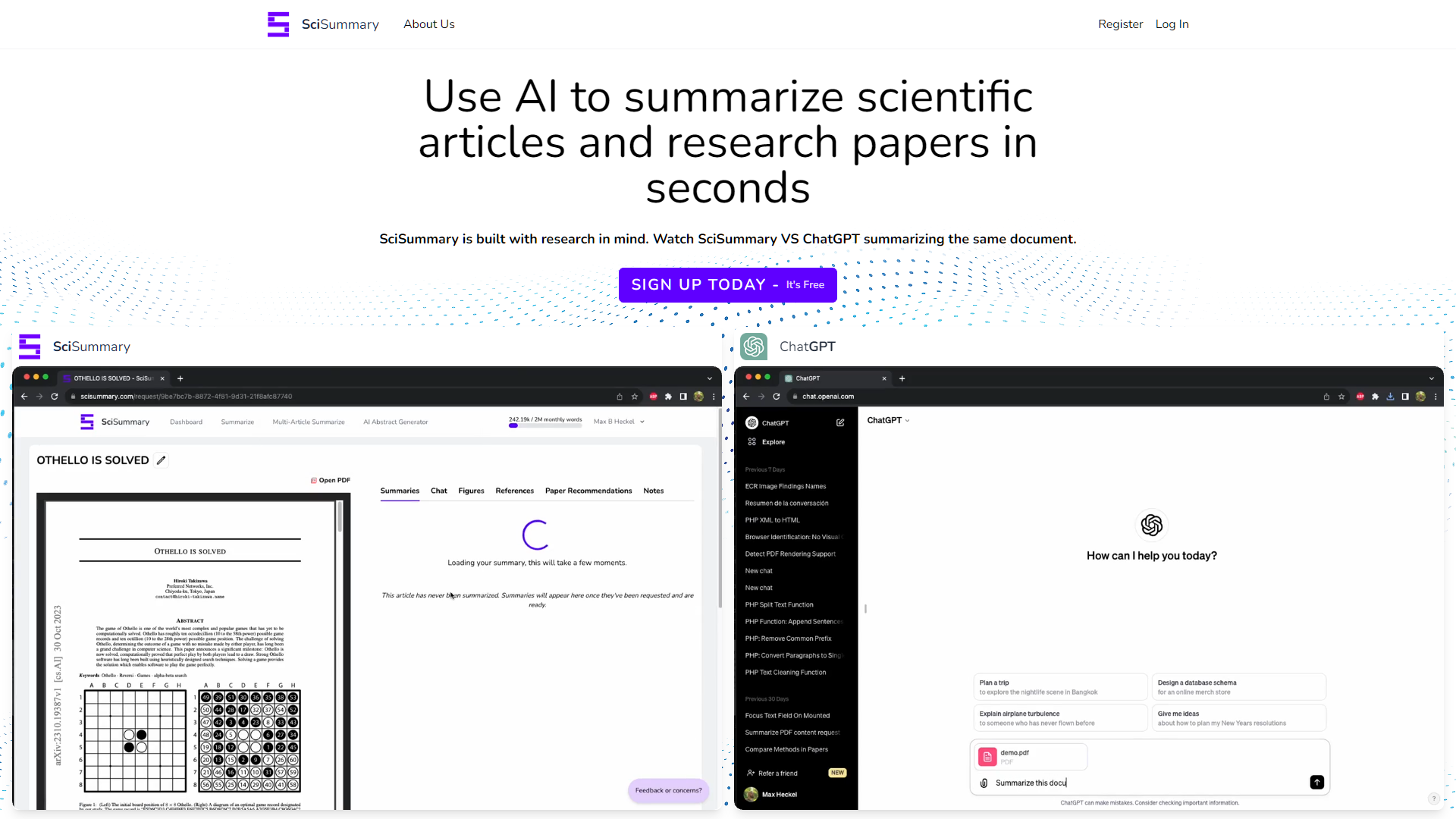
SciSummary is a specialized AI tool for summarizing and analyzing scientific research papers. Send a paper by email, upload a PDF, or paste a link, and you get a structured summary back in minutes. It handles documents up to 200,000 words, supports bulk summarization for comparing multiple studies, and lets you chat with figures to interpret charts, p-values, and confidence intervals. More than 900,000 users have summarized over 2.2 million papers with it, and it serves as the official AI provider for the ACM Digital Library.
Pricing: Free plan (10,000 words/month, roughly 2–5 papers, no card required); $4.99/month for 1M words; $8.99/month for 2M words; $299.99 one-time for lifetime access; pay-as-you-go available for occasional overflow. Annual billing saves 42%. Students get an unlimited first month free.
Pros:
Lowest-cost paid entry point in this category, with a genuinely usable free tier
Built specifically for scientific content: figure and table analysis, methodology breakdowns, citation extraction
Flexible input (email, dashboard, URL) and a REST API for bulk workflows
Cons:
Focused on reading and summarizing papers you already have; it is not a literature search engine, so discovery still happens in Google Scholar or PubMed
Web-based only, with no dedicated mobile app
2. Scholarcy
Best for: students who want summaries as reusable study material
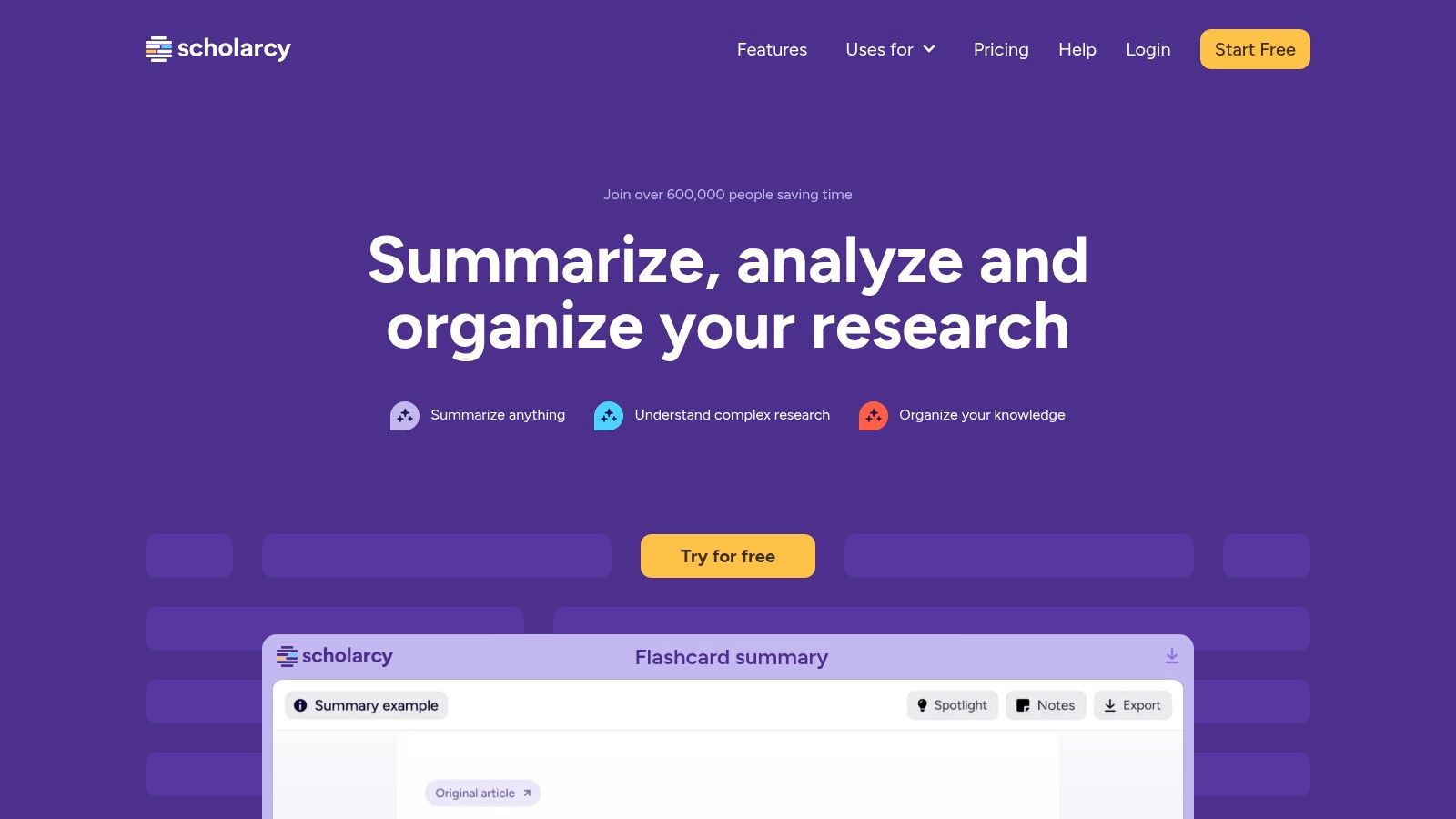
Scholarcy converts papers, reports, and book chapters into structured summary flashcards that capture the research question, methods, key findings, and references in a consistent, scannable format. Its distinctive strength is turning reading into retention: flashcards can be highlighted, organized into collections, and revisited, which makes it especially popular with students preparing for exams and researchers screening large reading lists. It also links citations to open-access versions of referenced papers.
Pricing: Free plan limited to 10 summaries; paid plan at $9.99/month with unlimited summarization, flashcard collections, and bulk export. A one-week free trial is available.
Pros:
Flashcard format is excellent for study, recall, and fast triage of a paper stack
Consistent structure across every summary makes scanning dozens of papers efficient
Figure, table, and reference extraction with open-access linking
Cons:
Roughly twice the monthly price of comparable summarization-focused tools
Works best on conventionally structured papers; messy formatting (unusual headings, heavy appendices) can degrade output
3. SciSpace
Best for: an all-in-one workspace from literature search to cited draft
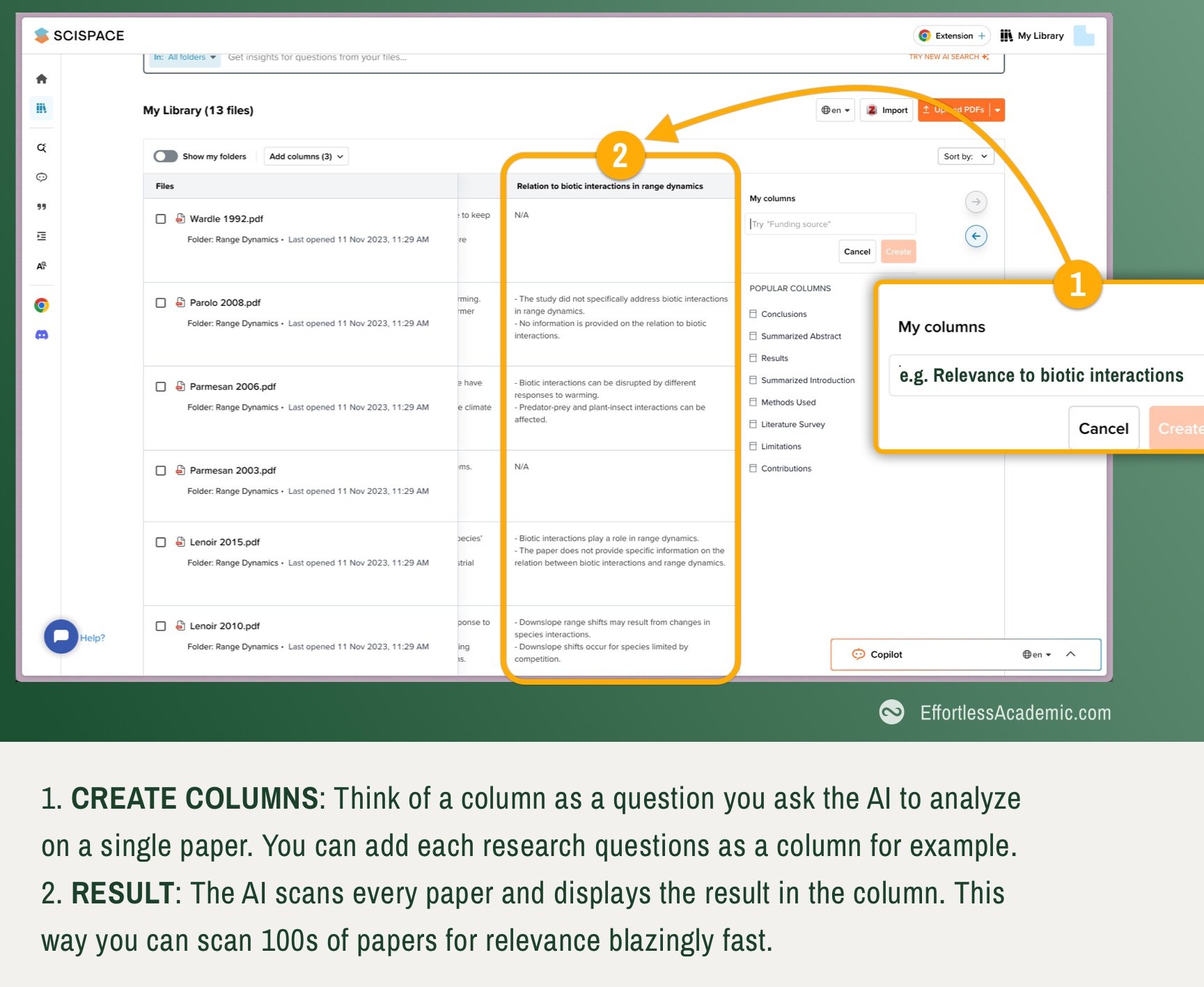
SciSpace pairs summarization with discovery: it searches across Google Scholar, PubMed, arXiv, OpenAlex, and Semantic Scholar, drawing from 280M+ papers, then lets you chat with PDFs, extract study details into comparison tables, and move into an AI Writer with reference management. Its Deep Review feature runs structured literature reviews across a thousand-plus papers. If you want one workspace that goes from "what should I read?" to a cited draft, SciSpace is the broadest platform on this list.
Pricing: Free tier; Premium at $12/month; Teams at $20/user/month. Credits are consumed by intensive research actions, while many exploration features remain unlimited.
Pros:
Widest literature search coverage in this comparison (280M+ papers across five databases)
Full workflow: search, read, extract, and write with references in one place
Strong agent features for automated literature reviews
Cons:
Credit-based pricing means heavy extraction and review work runs into limits quickly on free and lower tiers
Broader scope means more interface to learn; pure summarization is faster in dedicated tools
4. Elicit
Best for: systematic reviews and structured evidence synthesis
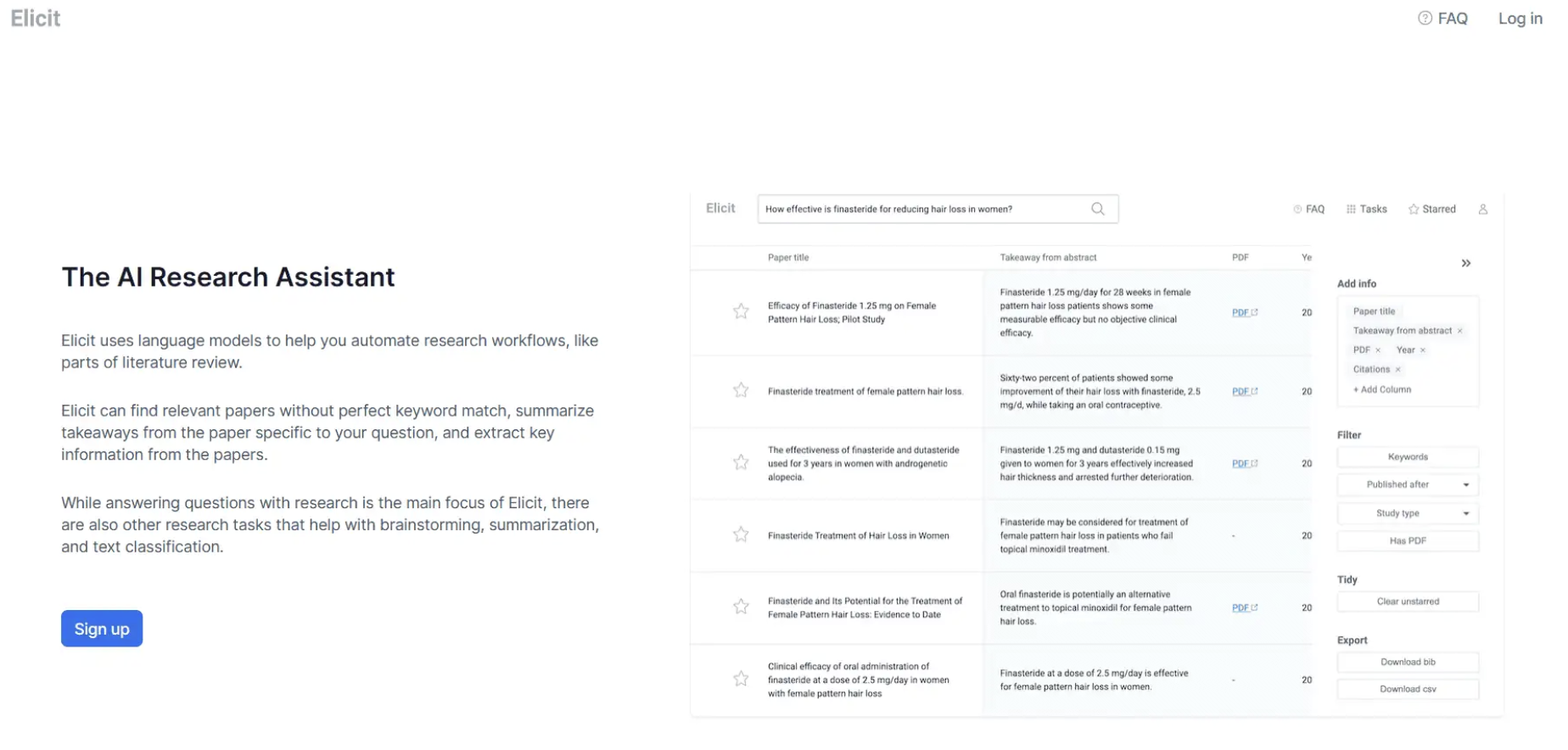
Elicit is an AI research assistant focused on finding, screening, and synthesizing academic papers. Ask a research question and it searches Semantic Scholar's ~138M papers, screens results, and extracts study details into clean, structured tables, a workflow it helped popularize and that remains its strongest feature. Reports generated by Elicit are consistently well structured and near-publication-ready, which is why it has become a default tool for formal evidence synthesis.
Pricing: Paid tiers start around $12/month; the Pro plan at $49/month unlocks the systematic review workflows that are Elicit's core strength. No student discount is currently offered.
Pros:
Best-in-class structured extraction and screening for systematic reviews
Clean, immediately usable report output
Citations attached to every claim for verification
Cons:
The features that define Elicit sit behind the $49/month Pro plan, the highest price point in this comparison
Narrower search corpus than multi-database platforms, and it doesn't help draft your paper
5. NotebookLM
Best for: synthesizing a source set you've already collected, for free
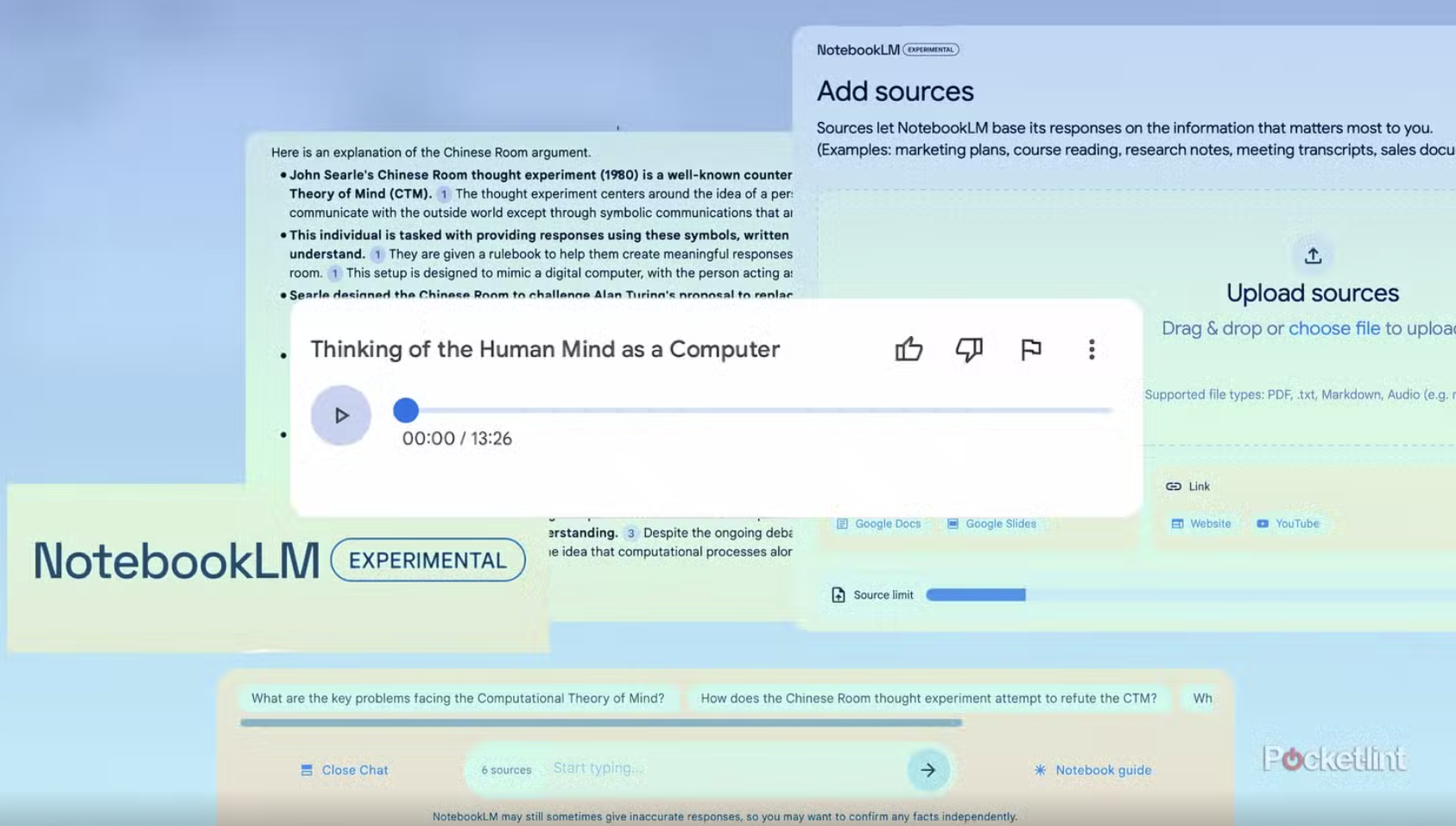
NotebookLM is Google's source-grounded AI notebook. It doesn't search the academic literature; instead, it synthesizes the sources you upload (50–300 documents depending on plan) into chat-based answers, mind maps, flashcards, quizzes, and even podcast-style audio discussions. For researchers who have already collected their papers and want to interrogate them as a set, or who learn better by listening, it's a uniquely flexible and free option.
Pricing: Free, with expanded limits available through Google's paid plans.
Pros:
Free, with a generous source limit
Unmatched output variety: audio overviews, mind maps, flashcards, slides
Answers stay grounded in your uploaded sources
Cons:
No literature search and no academic-specific structure awareness (it treats a paper like any other document)
Not built for scientific specifics like figure statistics or methodology assessment
Frequently asked questions
Which AI paper summarizer is the cheapest?
NotebookLM is free but isn't built for scientific structure. Among dedicated academic tools, SciSummary has the lowest paid entry point at $4.99/month (around $4/month billed annually), with a free tier good for 2–5 papers a month.
Which tool is best for a literature review?
It depends on the type. For formal systematic reviews with screening and extraction, Elicit. For broad exploratory reviews with search built in, SciSpace. For quickly understanding the papers on your list at the lowest cost, SciSummary's bulk summarization is the fastest route.
Can these tools replace reading papers?
No, and none of them should. Summarizers are triage and comprehension tools: they help you decide what deserves a full read and understand it faster when you do. For any paper central to your own work, read the original.
Do these tools work for non-English papers?
Support varies; most tools in this category perform best on English-language papers. Check each vendor's documentation for your language.
Why did we select these five tools?
They represent five genuinely different answers to the reading bottleneck: lowest-cost science-specific summarization (SciSummary), study-oriented flashcards (Scholarcy), an all-in-one workspace (SciSpace), systematic review workflows (Elicit), and free source-grounded synthesis (NotebookLM). Most researchers will find their fit among these five, and some will combine two.
Ready to clear your reading list? Try SciSummary free, no credit card required, at scisummary.com.